AI Architect
Learn to design, govern, and defend production AI systems. This program focuses on practical architecture judgment, not just theory, across two specialization tracks: Foundations for agentic-system builders, and Professional for people who own the full production lifecycle.
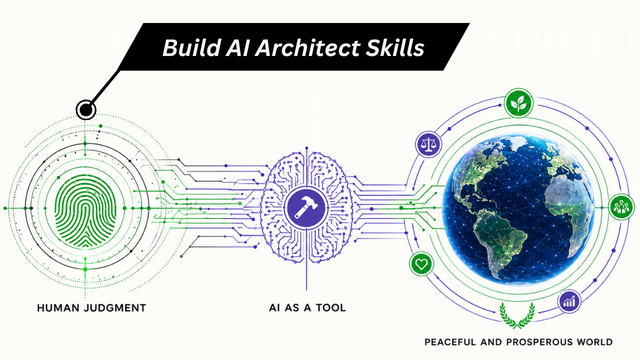
What does "Architect" actually mean?
An Architect is someone who designs how complex systems fit together, makes structural decisions that constrain what everyone else builds, and takes responsibility for tradeoffs other people have to live with.
If you've never thought about the word this way, that's fair — it's easy to hear "architect" and picture a job title, not a level of ownership. An architect operates one level above building a single system well. They decide how multiple systems, teams, and constraints fit together, and they're the ones accountable when that structure holds up, or doesn't.
-
DesignYou can translate a business or organizational problem into a coherent system architecture.
-
DecideYou can make structural tradeoffs, cost, latency, risk, complexity, and defend them.
-
GovernYou can define how a system stays safe, compliant, and maintainable after you've moved on.
-
CommunicateYou can explain the architecture and its tradeoffs to technical and non-technical stakeholders alike.
What an Architect is not expected to do is equally important. They're not necessarily the person writing every line of production code, or running the day-to-day operations of a single system. That work sits with the developers and teams who implement the architecture.
What is an AI Architect?
An AI Architect is a technical leader who can design, integrate, govern, and defend AI-powered systems across their full lifecycle, from a first architecture sketch through production, compliance, and the people who have to trust it.
Think of it as the step beyond building a single AI-powered application well. An AI Developer builds and ships one working system; an AI Architect is responsible for how many of those systems fit together, and answers for their reliability, security, and governance long after the first version ships. It's the top of this program's applied-skill ladder, not a job title everyone using AI needs.
-
Casual AI UserUses AI occasionally, with little structure.
-
AI AssociateApplies AI deliberately, and checks the work.
-
AI DeveloperBuilds and integrates AI-powered applications and solutions.
-
AI ArchitectDesigns, governs, and defends full AI systems for production.
What does an AI Architect do?
Not theory. Here's what this actually looks like day to day, owning AI-powered systems end to end.
Design agentic architectures
Translate a business problem into an end-to-end architecture, and choose between workflow, agentic, and augmented-LLM patterns.
Orchestrate multi-agent systems
Design coordinator/subagent structures, task decomposition, context passing, and session state, forking, and resumption.
Design reliable tool interfaces
Write tool descriptions and structured error responses that hold up under load, and scope tool access to prevent selection ambiguity.
Design integration architecture
Evaluate connection protocols, authentication and authorization requirements, retrieval pipelines, and observability at scale.
Configure AI coding assistants for teams
Set repository-level instruction hierarchies, reusable commands and skills, path-specific rules, and CI/CD integration.
Engineer prompts for precision
Write explicit criteria and few-shot examples, and enforce schema-validated structured output with retry and feedback loops.
Select and engineer around models
Choose the right model for the tradeoffs, design system prompts and guardrails, and manage context windows, caching, and reuse.
Manage context across long sessions
Preserve critical facts, trim verbose tool output, and counteract position effects and context degradation in long-running work.
Evaluate and optimize at scale
Define evaluation metrics, build test frameworks and A/B tests, and diagnose whether a failure is a prompt, retrieval, or model problem.
Design for governance and safety
Build guardrails, human-in-the-loop review, and compliance controls into the architecture itself, not bolted on after.
Communicate and manage the lifecycle
Run structured discovery, communicate architectural tradeoffs to stakeholders, and support a system from discovery through monitoring and iteration.
Improve developer productivity and operations
Configure AI development tools and environments for teams, and support debugging and operational issue resolution.
Which level is yours?
Both tracks are built around the architecture skills real production AI systems demand. Foundations proves you can build production-grade agentic systems. Professional proves you can own their full lifecycle, from architecture through governance.
AI Architect – Foundations
For builders who design and implement agentic systems with modern agent SDKs, AI coding assistants, and tool-integration protocols, and need to make sound tradeoffs about architecture, configuration, and reliability.
AI Architect – Professional
For architects and technical leads who own the full lifecycle of an AI-powered system: solution design, integration, evaluation, governance, and stakeholder communication. An AI Architect turns an idea into a production-ready system.
What skills does AI Architect – Foundations build?
These are the five areas this track is built around: the practical skills an architect needs to design, orchestrate, and ship production-grade agentic systems.
Agentic Architecture & Orchestration
Design agentic loops with clear stop conditions, orchestrate coordinator-subagent systems, and manage session state, forking, and resumption.
Tool Design & Integration Protocols
Write tool descriptions and error responses that hold up under production load, and configure external tool servers and built-in tools without creating selection ambiguity.
AI Coding Assistant Configuration & Workflows
Configure repository-level instruction hierarchies, custom commands and reusable skills, and path-specific rules, and know when a plan-first workflow earns its cost over direct execution.
Prompt Engineering & Structured Output
Design prompts with explicit criteria instead of vague instructions, apply few-shot examples, and enforce structured output with tool use and JSON schemas.
Context Management & Reliability
Preserve critical information across long sessions, design escalation and error-propagation patterns, and calibrate human review workflows.
Ready to architect real systems
You'll be able to design and implement agentic systems with a modern agent SDK, from a single agent to full multi-agent orchestration.
You'll know how to design tool integrations and structured error handling that hold up under real production load.
You'll have the production-ready skills to pursue a vendor certification exam, if and when you want one.
You'll know when to reach for hooks, structured output, and context management patterns instead of hoping the prompt holds.
Built for people ready to own architecture decisions
You've completed AI Fundamentals, AI Associate, and AI Developer, or have equivalent experience.
You have 6+ months of practical experience building with an agent SDK, an AI coding assistant, or tool-integration protocols.
You're comfortable making architecture, configuration, and tradeoff decisions, not just following a spec.
You want to build agentic systems that hold up in production, not just in a demo.
Ready for the next level? Explore AI Architect – Professional →
What skills does AI Architect – Professional build?
These are the seven areas this track is built around: the practical skills an architect needs to own an AI-powered system's full lifecycle, from design through governance.
Solution Design & Architecture
Translate business problems into AI-based solutions, design end-to-end architectures, and choose between workflow, agentic, and augmented-LLM patterns.
AI Model Selection, Prompting & Context Engineering
Select the right model for the tradeoffs, design system prompts and guardrails, and manage context windows, caching, and reuse.
Integration
Design RAG pipelines with the right chunking and retrieval strategy, evaluate tool-integration, API/CLI, and agent-to-agent protocols, and close authentication and observability gaps before they become incidents.
Evaluation, Testing & Optimization
Define evaluation metrics, build test frameworks and run A/B tests, and diagnose whether a failure is a prompt problem, a retrieval problem, or a model mismatch.
Governance, Safety & Risk Management
Implement guardrails and human-in-the-loop validation, and design for compliance regimes like GDPR, HIPAA, and FedRAMP.
Stakeholder Communication & Lifecycle Management
Run structured discovery, communicate architectural tradeoffs to non-technical stakeholders, and support a system from discovery through monitoring and iteration.
Developer Productivity & Operational Enablement
Configure AI development tools and environments for teams, improve developer workflows with AI-assisted tooling, and support debugging and operational issue resolution.
Ready to own the full lifecycle
You'll be able to design end-to-end AI solutions, from discovery through deployment and monitoring.
You'll know how to evaluate integration protocols, RAG pipelines, and observability strategies at scale.
You'll have the production-ready skills to pursue a vendor certification exam, if and when you want one.
You'll know how to fold governance, compliance, and stakeholder communication into an architecture decision, not bolt it on after.
Built for architects and technical leads
You've completed AI Architect – Foundations, or have equivalent hands-on experience.
You have 3+ years in systems architecture or platform engineering, and 6+ months hands-on with a leading LLM platform in production.
You've delivered end-to-end systems before, from discovery through operationalization.
You want to own or significantly contribute to the full lifecycle of an AI-powered system, including its governance, safety, and stakeholder story.
New here? Start with AI Architect – Foundations →
What's outside even the Architect's role?
Knowing the edges of this role is part of the judgment it teaches, not a weakness. Here's what an AI Architect isn't expected to do alone, because it belongs to deeper specialization Osman Academy doesn't teach.
Frontier model training or foundational ML research, that's an ML research scientist's territory.
Formal legal sign-off on GDPR, HIPAA, or FedRAMP compliance, that's a compliance or legal specialist's territory.
Independent security audits and penetration testing, that's a dedicated security specialist's territory.
Enterprise-wide budget ownership and vendor contract negotiation, that's an engineering or product executive's territory.
Writing every line of the system it governs, that's the AI Developers and engineers implementing the architecture.
Recognizing when a decision needs one of those specialists, and bringing them in early, is exactly the kind of judgment this program is built to teach.
How Osman Academy develops these abilities
The program moves through four stages, each one building on the last, moving you from knowing the patterns to defending real architecture decisions.
Learn
Understand the patterns through short lessons, real-world case studies, and reference architectures.
Practice
Build the judgment through guided architecture exercises and configuration labs.
Apply
Defend tradeoffs on realistic scenarios: cost, latency, risk, and compliance all at once.
Master
Demonstrate combined skill and judgment through an integrated capstone system design.
The same family behind every Osman Academy course
Written and taught by Osman Mohammed (12+ years software engineering, Big 4 consulting delivery), with instructional design by Firdous Osman and business context from Abdul Bari Mohammed. Meet the full team →
What comes after AI Architect?
Nothing formal. AI Architect is the capstone of the Practical AI Skills Program, and Osman Academy doesn't teach a level beyond it. What comes next is real production ownership: systems you design, defend, and govern, judged by whether they hold up, not by another course.
Growth from here runs through experience and, where it makes sense, deeper specialization: security, compliance, ML research, or engineering leadership. This program gets you to the point where you can recognize which of those you need, and when.
New here? Start with AI Fundamentals →About this path specifically
Is this an official vendor-certified course?
No. Osman Academy is an independent training provider and isn't affiliated with, endorsed by, or a training partner of any AI vendor. This program teaches vendor-agnostic architecture skills, though its curriculum design references publicly available industry certification blueprints, so completing it can also help prepare you for a vendor's exam as an optional bonus. No vendor guarantees that any preparation resource, including this one, ensures a passing result.
Do I have to take a vendor certification exam to complete either course?
No. Each course teaches the underlying skills regardless. Sitting a vendor's official certification exam is a separate, optional step entirely outside this program, with its own fee and registration process through that vendor.
Do I need to complete Foundations before Professional?
There's no formal prerequisite between the two tracks. Practically, we strongly recommend Foundations first: Professional assumes the hands-on agent-building, AI coding assistant, and tool-integration fluency it builds, plus real production experience.
Do I need AI Fundamentals, AI Associate, and AI Developer first?
They're recommended, not required. This is the capstone of the Osman Academy program, and each earlier path builds skills the Architect tracks assume.
When will these courses be available?
[Draft] Both AI Architect tracks are in active development. Enrollment details will be posted here once they're ready.
Where will these courses be hosted?
[Draft] Like every Osman Academy course, they'll be delivered and hosted through Udemy.