AI Fundamentals
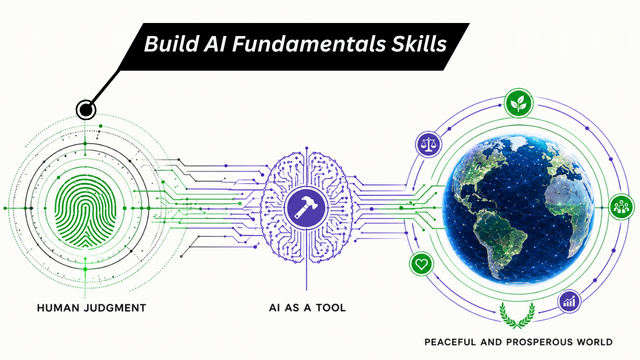
Understand what makes human judgment unique, how modern AI actually works, and how the two can work together responsibly. This is the beginner-friendly starting point for a clear conceptual understanding, before you apply or build with AI.
What does "Fundamentals" mean?
Fundamentals are the essential principles, concepts, and basic skills that form the foundation of a subject, system, or practice.
They give you the knowledge needed to understand how something works, why it works, and how its different parts relate to one another. More advanced knowledge builds on this foundation.
-
Principles explain the underlying rules and ideas.
-
Concepts give you the language needed to think and communicate clearly.
-
Basic skills help you put your understanding into practice.
-
Sound judgment helps you recognize when, why, and how that knowledge should be applied.
Learning the fundamentals does not mean learning everything. It means building a reliable mental framework that makes later learning easier to understand, evaluate, and apply. Just as a strong structure depends on its foundation, lasting knowledge depends on a clear understanding of the fundamentals.
What does "AI Fundamentals" mean?
AI Fundamentals is the foundational learning level where you develop the concepts and judgment needed to understand AI before trying to use it professionally or build systems with it.
At this level, you're not learning to operate AI tools yet. You're building the mental model that makes everything after this course make sense. This level helps you:
Understand essential concepts before you rely on them.
Develop an accurate mental model of how AI actually works.
Separate real capabilities from exaggerated claims.
Recognize important limitations before you depend on AI.
Understand the continuing role of human judgment.
Prepare for more applied or technical learning later.
To be clear about what this isn't: this is not primarily a prompting course, a coding course, a machine-learning course, or a certification-preparation course. Those are useful goals — they just belong to a later stage.
-
AI FundamentalsUnderstand AI.
-
AI AssociateApply AI to professional work.
-
AI DeveloperBuild AI-enabled applications.
-
AI ArchitectDesign complete production AI systems.
Why begin with humans?
To understand artificial intelligence, you first need a clear point of comparison: human beings. Before this course explains what AI is, it begins with what makes a person a person — because human beings and human intelligence are the baseline against which AI is understood.
-
Lived experience — a history of moments that shapes how you see the world.
-
Needs and motivations — reasons for acting that come from within, not from a prompt.
-
Emotion and relationships — feelings that connect you to other people and shape decisions.
-
Values and ethical judgment — a sense of right and wrong you can reason about and defend.
-
Imagination and purpose — the ability to picture what doesn't exist yet and work toward it.
-
Responsibility for decisions and outcomes — being answerable for what you choose to do.
-
The ability to create tools and institutions — including AI itself.
At the center of many of these abilities is human intelligence — our natural capacity to perceive the world, learn from experience, reason, feel, imagine possibilities, make decisions, solve problems, communicate, cooperate, and act with purpose.
What is human intelligence?
Human intelligence is the natural human capacity to perceive, learn, reason, feel, imagine, make decisions, solve problems, and adapt through experience.
Human intelligence is not one isolated ability. It emerges from many connected parts of being human: our biology, perception, memory, emotions, needs, experiences, relationships, values, and ability to reflect on our own actions.
In simple terms, human intelligence helps us move through a continuous cycle:
We take in information from the world, interpret what it means, connect it with what we already know and have experienced, consider possible actions, make a choice, act, and learn from what happens next.
But human intelligence does not operate only at the individual level. People use intelligence together.
Through communication and cooperation, humans share knowledge, coordinate their actions, solve problems, and build things that no individual could create alone.
And among the tools humans have created is artificial intelligence.
AI therefore does not appear at the beginning of this story. It appears much later.
Humans came first. Natural intelligence came first. Artificial intelligence is something humans created.
That is why this course begins with natural human intelligence before artificial intelligence. To understand AI clearly, we first need to understand the intelligence it is designed to reproduce, extend, or support — and just as importantly, what remains distinctly human.
What the course actually teaches
Eleven modules, in two connected foundations, walked in order: Human Foundations first, so you understand what AI is being compared to, then AI Foundations, so you can see precisely where the resemblance ends and where it doesn't.
1. The Human Question
Why no single field fully explains a person, and why that matters when studying AI.
2. How Humans Think, Feel, and Decide
How needs, perception, emotion, and experience influence decisions.
3. How Humans Connect and Choose Right from Wrong
How relationships, culture, values, and ethics shape human decisions.
4. Why Humans Work and Build Tools
Why humans imagine, create, cooperate, and organize work.
5. Where AI Fits in the Human Story
How AI belongs within the longer history of human-created tools.
6. What Is Artificial Intelligence?
A clear definition of AI, why it was created, and how it differs from ordinary software.
7. Data and How Machines Learn
How data and training produce a working model.
8. Neural Networks, Large Language Models, and Generative AI
How modern tools such as ChatGPT and Claude work conceptually.
9. Why AI Appears Smart — and Why It Can Be Wrong
Why generated output can be fluent, useful, inaccurate, or misleading.
10. Real AI Systems and Their Limits
How models, data, software, policies, and humans form a complete system.
11. Humans, Work, and What Comes Next
How AI changes tasks and workflows while humans remain responsible for its use.
What you'll be able to do
By the end of the course, you will be able to explain what modern AI is, describe how it works conceptually, evaluate its capabilities and limitations, and explain why human judgment remains essential.
Explain what AI is without relying on technical jargon.
Distinguish AI from ordinary software.
Describe how data, training, and models are connected.
Explain how machine learning, neural networks, large language models, and generative AI relate to each other.
Recognize why a confident AI answer may still be incorrect.
Separate an AI model from a complete AI system.
Identify suitable and unsuitable expectations of AI.
Discuss how AI can change tasks and workflows.
Explain why humans remain responsible for consequential decisions.
Continue confidently into the AI Associate learning level.
Who this course is for
Complete beginners with no prior AI knowledge.
People with no programming experience.
People who use AI casually but don't understand how it actually works.
Professionals who want to evaluate AI claims more confidently.
Students and educators seeking a conceptual foundation.
Business professionals preparing to adopt AI responsibly.
Anyone planning to continue to AI Associate, AI Developer, or AI Architect.
No coding required
Every concept is explained in plain language, with no lines of code to write.
No mathematics background required
No equations or formulas — ideas are explained through examples and comparisons.
No previous AI experience required
Built for people starting from zero, whether or not you've used an AI tool before.
What comes after AI Fundamentals?
After learning what AI is and how it fits into human work, AI Associate teaches you how to apply AI competently, critically, and responsibly in everyday professional workflows.
The distinction is worth keeping clear: AI Fundamentals develops understanding. AI Associate develops practical workplace application. One gives you the mental model; the other puts it to work.
Continue to AI Associate →Frequently asked questions
Do I need prior experience?
No. This is the total-beginner entry point to every other path on Osman Academy.
Is coding or mathematics required?
No. Every concept is explained in plain language, without writing code or working through equations.
How long does the course take?
It's self-paced, designed to be completed over a handful of focused sessions rather than a long, drawn-out course.
What learning activities are included?
Short lessons, plain-language explanations, and visual guides, paired with recall and comparison exercises that check your understanding as you go.
Is there a project or assessment?
The course includes applied exercises that ask you to evaluate realistic AI claims and outputs using what you've learned.
Where is the course hosted?
Delivered and hosted through Udemy, like every Osman Academy course. Enrollment details are posted here as soon as they're live.
Does Osman Academy issue a certificate?
Course delivery and completion tracking are handled through Udemy. Osman Academy does not issue its own completion certificate at this time.
What should I study next?
Once you've completed AI Fundamentals, AI Associate is the next step — it builds on these concepts with practical, everyday professional AI skills.