AI Associate
Learn to use AI competently, critically, and responsibly in real workplace situations. This program focuses on practical, professional AI skills. No coding required.
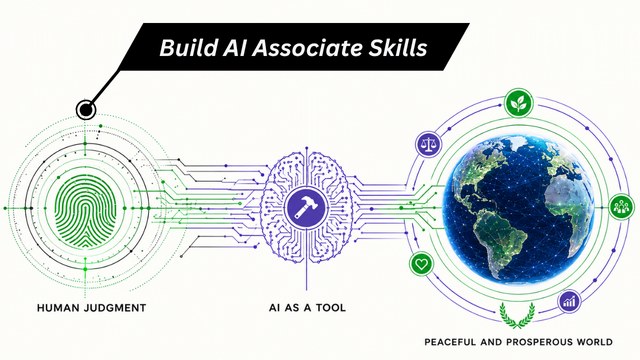
What does "Associate" actually mean?
An Associate is someone who has moved beyond basic understanding and can apply a skill competently in common, everyday situations with minimal guidance.
If you've never heard the term used this way, that's fair — it's not obvious. "Associate" describes a level of applied skill, not necessarily a job title. It means you've moved past simply understanding the basic idea of something. You can perform common, everyday tasks competently, usually with minimal guidance.
-
UnderstandYou understand the basic concepts and know what the skill is for.
-
ApplyYou can perform common tasks competently with minimal guidance.
-
Recognize LimitsYou know when a task is outside your depth or needs another review.
-
EscalateYou know when more advanced or technical expertise is required.
What an Associate is not expected to do is equally important. They are not yet responsible for designing or building complex technical systems. That comes further down the progression.
What is an AI Associate?
An AI Associate is a professional who can independently apply AI to everyday work, evaluate its results, use it responsibly, and recognize when human or technical expertise is required.
Think of it as the space between a casual AI user and a technical AI practitioner. A casual user experiments, poking around without much structure. An AI Associate goes further, applying AI deliberately, checking the output, and knowing the boundaries of their own responsibility. It's a competency level you build, not necessarily a job title you're given.
-
Casual AI UserUses AI occasionally, with little structure.
-
AI AssociateApplies AI deliberately, and checks the work.
-
AI DeveloperBuilds AI-powered applications and tools.
-
AI ArchitectDesigns full AI systems for production.
What does an AI Associate do?
Not theory. Here's what this actually looks like day to day, using AI as part of real professional work.
Research and summarize
Pull information from multiple sources into a clear, usable summary.
Draft and improve content
Write and refine professional documents, emails, and reports.
Evaluate AI output
Check an AI-generated answer for accuracy before anyone else sees it.
Spot errors and bias
Catch hallucinations, inconsistencies, and skewed framing before they cause a problem.
Improve repetitive processes
Use AI to speed up the parts of a workflow that eat the most time.
Choose the right tool
Pick the AI tool, feature, or model that actually fits the task.
Integrate AI into workflows
Fold AI into how the work already gets done, not as a separate step.
Handle information responsibly
Know what's safe to share with an AI tool, and what isn't.
Explain AI to others
Describe what AI can and can't do to a colleague or stakeholder who doesn't use it.
What skills does an AI Associate need?
These are the seven areas this program is built around. Together, they're what separates someone who happens to use AI from someone who uses it well.
Prompting and Task Execution
Structure requests clearly, break complex tasks into steps AI can execute well, and improve results by iterating on the prompt.
Output Evaluation and Validation
Judge accuracy and completeness, catch hallucinations and bias, fact-check anything important, and know when a result needs human review.
Product and Model Selection
Choose the right AI tool, feature, or model for the task, weighing quality, speed, and cost.
Workflow Integration and Solution Design
Use AI for research, planning, analysis, and content work, while explaining its value and limits to people who rely on the output.
Configuration and Knowledge Management
Set up an AI workspace or project with clear instructions, approved knowledge sources, and context that stays current.
Governance, Risk, and Responsible Use
Protect sensitive information, follow your organization's policies, and recognize privacy, regulatory, and ethical considerations before they become problems.
Troubleshooting and Optimization
Diagnose a weak prompt or a poor result, adjust the approach, and improve the workflow based on what actually happens.
What's outside the AI Associate's role?
Knowing the edges of your role is part of the skill, not a weakness. Here's what an AI Associate isn't normally expected to do, because it belongs to the next level.
Recognizing when a task needs one of those skills, and asking for it, is exactly the kind of judgment this program is built to teach.
How Osman Academy develops these abilities
The program moves through four stages, each one building on the last, moving you from knowing about AI to applying it confidently in real work.
Learn
Understand the concepts through short lessons, visual guides, and real examples.
Practice
Build the skill through guided exercises, repetition, and feedback.
Apply
Use judgment on realistic workplace scenarios and practical assignments.
Master
Demonstrate combined knowledge and judgment through a capstone project.
The same family behind every Osman Academy course
Written and taught by Osman Mohammed (12+ years software engineering, Big 4 consulting delivery), with instructional design by Firdous Osman and business context from Abdul Bari Mohammed. Meet the full team →
From knowing to doing
By the end of the program, you'll be able to take a real workplace problem, decide whether AI is appropriate, structure the task, choose the right approach, evaluate the result, and deliver useful work responsibly.
Complete structured workplace tasks with minimal guidance.
Produce clearer, more reliable AI-assisted work.
Catch important AI errors before sharing results.
Make appropriate tool and model choices.
Improve workflows using AI.
Protect sensitive information.
Recognize when additional review or technical expertise is required.
Complete a portfolio-ready practical project.
What comes after AI Associate?
AI Developer teaches you to design, integrate, evaluate, and secure AI-powered applications, agents, and workflows, turning the judgment you built here into working software.
The distinction is worth keeping clear: AI Associate uses AI deliberately inside existing tools. AI Developer builds the applications, agents, and integrations other people use, and takes responsibility for how they behave. One gives you the mental model; the other puts it to work.
Continue to AI Developer →About this path specifically
Do I need AI Fundamentals first?
It's recommended, not required, but if you don't yet have a clear conceptual understanding of what AI is, AI Fundamentals is the better starting point.
When will this course be available?
[Draft] AI Associate is in active development. Enrollment details will be posted here once it's ready.
Where will this course be hosted?
[Draft] Like every Osman Academy course, it will be delivered and hosted through Udemy.