AI Developer
Learn to design, integrate, evaluate, and secure AI-powered applications, agents, and workflows. This program focuses on practical developer judgment, not just API calls. Comfort with code, the command line, and REST APIs is recommended.
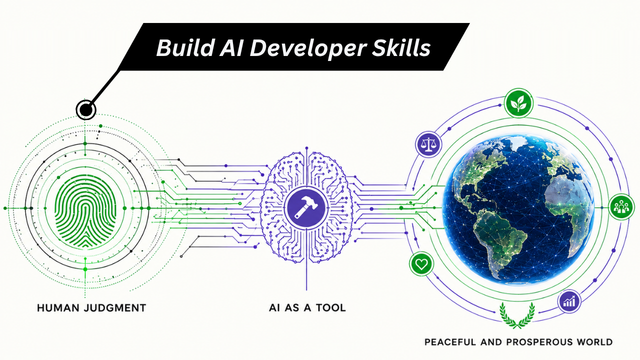
What does "Developer" actually mean?
A Developer is someone who can turn problems or requirements into working technical solutions by designing, building, testing, and improving them.
"Developer" describes someone who goes beyond using existing tools to complete a task. A developer creates solutions that other people or systems can use. They understand the problem, determine how technology can help, build the solution, test whether it works, and improve it when needed.
-
DesignYou can translate a problem or requirement into a practical technical solution.
-
BuildYou can implement the solution using appropriate tools, technologies, and code.
-
EvaluateYou can test whether the solution works correctly and meets its intended requirements.
-
IntegrateYou can connect the solution with the applications, data, tools, and workflows it needs to operate.
What a Developer is not expected to do is equally important. They are not necessarily responsible for designing the architecture of large, complex technical systems across an organization. That comes further down the progression.
What is an AI Developer?
An AI Developer is a technical practitioner who can design, build, evaluate, and integrate AI-powered applications and solutions that solve real-world problems.
Think of it as the step beyond applying AI to your own work. An AI Associate works effectively with AI; an AI Developer builds things with AI. They can take a problem, determine where AI can contribute, select appropriate models and tools, build the application, evaluate how it behaves, and integrate it into a working solution. It's a technical competency level focused on creating with AI, not simply using it.
-
Casual AI UserUses AI occasionally, with little structure.
-
AI AssociateApplies AI deliberately, and checks the work.
-
AI DeveloperBuilds and integrates AI-powered applications and solutions.
-
AI ArchitectDesigns full AI systems for production.
What does an AI Developer do?
Not theory. Here's what this actually looks like day to day, building real AI-powered software.
Choose workflow vs. agent
Decide whether a deterministic workflow or an autonomous agent better fits a multi-step task.
Integrate through an API or SDK
Connect an AI model into an application with streaming and recoverable error handling where appropriate.
Pick a processing strategy
Select realtime or batch processing for a workload based on urgency, volume, and cost.
Isolate untrusted content
Structure trusted instructions and isolate untrusted input to reduce prompt-injection risk.
Build a reusable tool
Create a tool or MCP integration that connects an AI model to an internal service.
Manage long-running context
Keep context relevant and efficient across multi-step, long-running work.
Validate structured output
Check structured output against a schema before another system consumes it.
Compare model options
Weigh capability, latency, cost, and release changes when choosing a model.
Diagnose a failure's origin
Determine whether a failure sits in application logic, integration, tool execution, context, or model output.
What skills does an AI Developer need?
These are the eight areas this program is built around: the practical skills a developer needs to design, build, secure, and ship real AI-powered software.
Agent & Workflow Design
Decide whether a task needs a fixed, predictable workflow or a more autonomous agent, then build that structure so it behaves reliably — supervisor/subagent patterns, stopping conditions, and human checkpoints included.
Application & API Integration
Turn a defined requirement into a working application that calls an AI model through an API or SDK: authentication, retries, streaming vs. batch processing, and configuration that holds up beyond a demo.
Responsible AI Coding Assistant Configuration
Configure an AI coding environment deliberately inside a real codebase — repository instructions, permission settings, and reusable commands — instead of leaving it to guess your conventions.
Evaluation, Testing & Debugging
Use evidence, not guesswork, to find out why an AI-powered system failed: trace inspection, error classification, and repeatable tests that confirm a fix actually worked.
Model Selection & Cost/Latency Optimization
Choose the model, thinking configuration, and processing strategy that fits a task's quality, latency, and cost needs, and justify that choice with real measurement rather than assumption.
Prompt & Context Engineering
Design the instructions, examples, and context an AI application relies on, isolate untrusted input, and validate structured output before another system consumes it.
Security & Safe Deployment
Apply least-privilege access and layered safeguards so an AI-powered system resists misuse: prompt-injection defenses, secrets protection, and guardrails for high-risk actions.
Tool & MCP Development
Connect AI models to real external capabilities through clear, reliable interfaces: tool schemas, approval workflows for consequential actions, and MCP servers for internal systems.
What's outside the AI Developer's role?
Knowing the edges of your role is part of the skill, not a weakness. Here's what this foundational developer program doesn't by itself cover, because it belongs to deeper specialization or the next level.
Recognizing when a decision needs deeper security, legal, or architectural expertise, and escalating it, is exactly the kind of judgment this program is built to teach.
How Osman Academy develops these abilities
The program moves through four stages, each one building on the last, moving you from knowing about AI to shipping working software with it.
Learn
Understand the concepts through short lessons, diagrams, and real examples.
Practice
Build the skill through guided coding labs, configuration exercises, and feedback.
Apply
Use judgment on realistic scenarios: requirements, tradeoffs, and implementation.
Master
Demonstrate combined skill and judgment through an integrated capstone project.
The same family behind every Osman Academy course
Written and taught by Osman Mohammed (12+ years software engineering, Big 4 consulting delivery), with instructional design by Firdous Osman and business context from Abdul Bari Mohammed. Meet the full team →
From concepts to shipped software
By the end of the program, you'll be able to take a defined need, choose the right AI application, agent, or workflow approach, build and secure it, evaluate its behavior with evidence, and communicate its limits and risks responsibly.
Analyze a defined need and select an appropriate AI application, workflow, or agent pattern.
Integrate an AI model through an API or SDK using sound software-engineering practices.
Configure model, prompt, context, tools, and output handling for a stated requirement.
Compare model and processing choices against quality, latency, and cost constraints.
Create or integrate tools and MCP capabilities with clear schemas and error handling.
Evaluate output quality, analyze traces, and diagnose common failure modes.
Apply layered safeguards for prompt injection, untrusted input, and data leakage.
Use an AI coding assistant and repository-level configuration responsibly.
Escalate decisions that need deeper security, legal, or architecture expertise.
Complete a portfolio-ready AI-powered application or workflow.
What comes after AI Developer?
AI Architect teaches you to design and govern AI systems across an organization: enterprise-wide strategy, distributed-systems architecture, and full-lifecycle governance, turning the software you can build into systems other teams can safely build on.
The distinction is worth keeping clear: AI Developer builds and ships a working AI-powered application or agent. AI Architect owns how many of those systems fit together across an organization, and answers for their strategy, reliability, and governance. One gives you the ability to build; the other gives you the ability to own the whole system.
Continue to AI Architect →About this path specifically
Do I need AI Fundamentals and AI Associate first?
They're recommended, not required, though this path assumes working knowledge of software development, LLM fundamentals, and API-based applications.
When will this course be available?
[Draft] AI Developer is in active development. Enrollment details will be posted here once it's ready.
Where will this course be hosted?
[Draft] Like every Osman Academy course, it will be delivered and hosted through Udemy.